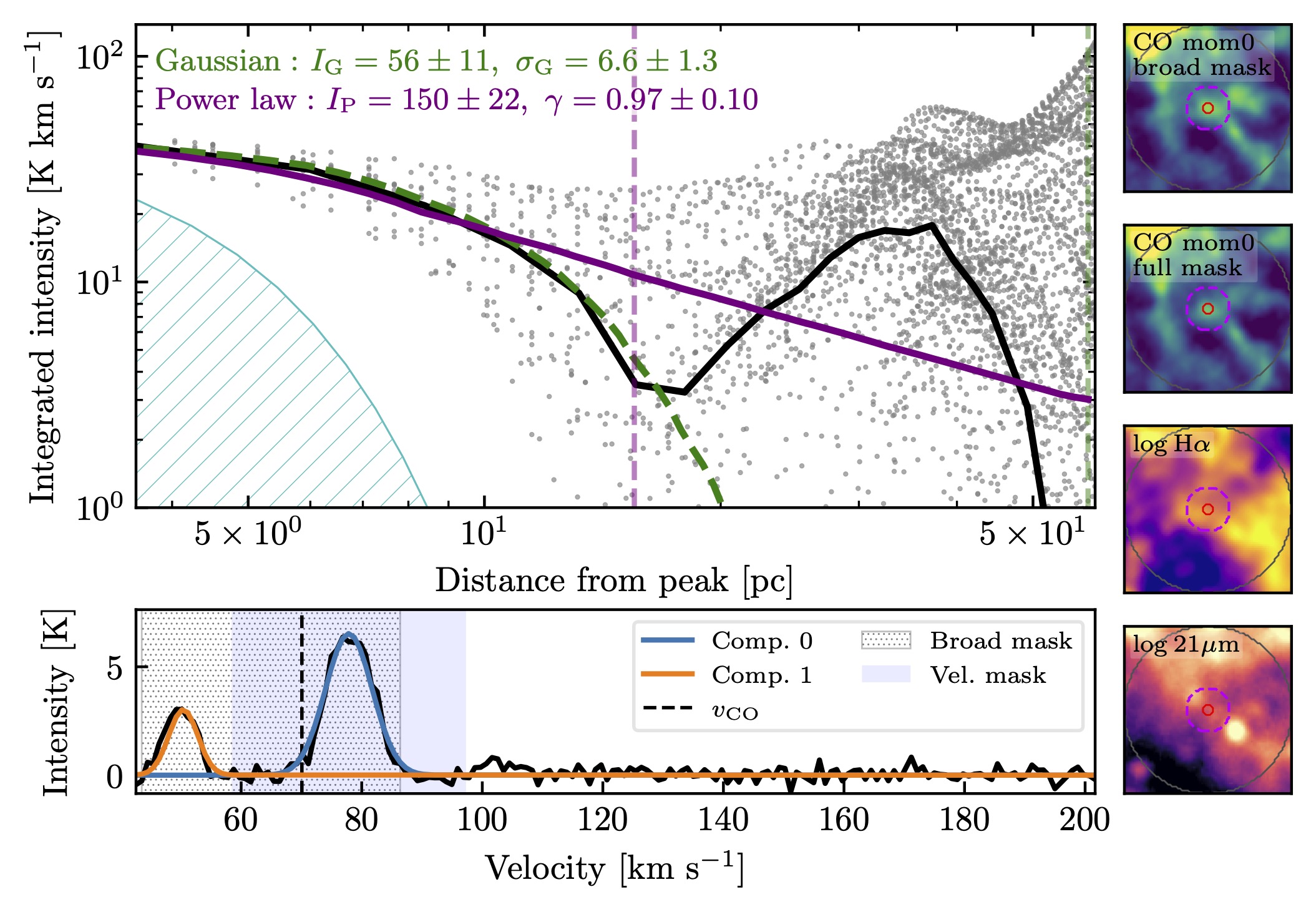
Radial CO density profile for an individual structure. In the lower panel, we show the multi-peaked intensity spectrum, while the right postage stamps highlight multiwavelength emission in its neighborhood. This radial structure encodes important information about the physical state of the gas, and how it may collapse to form stars.
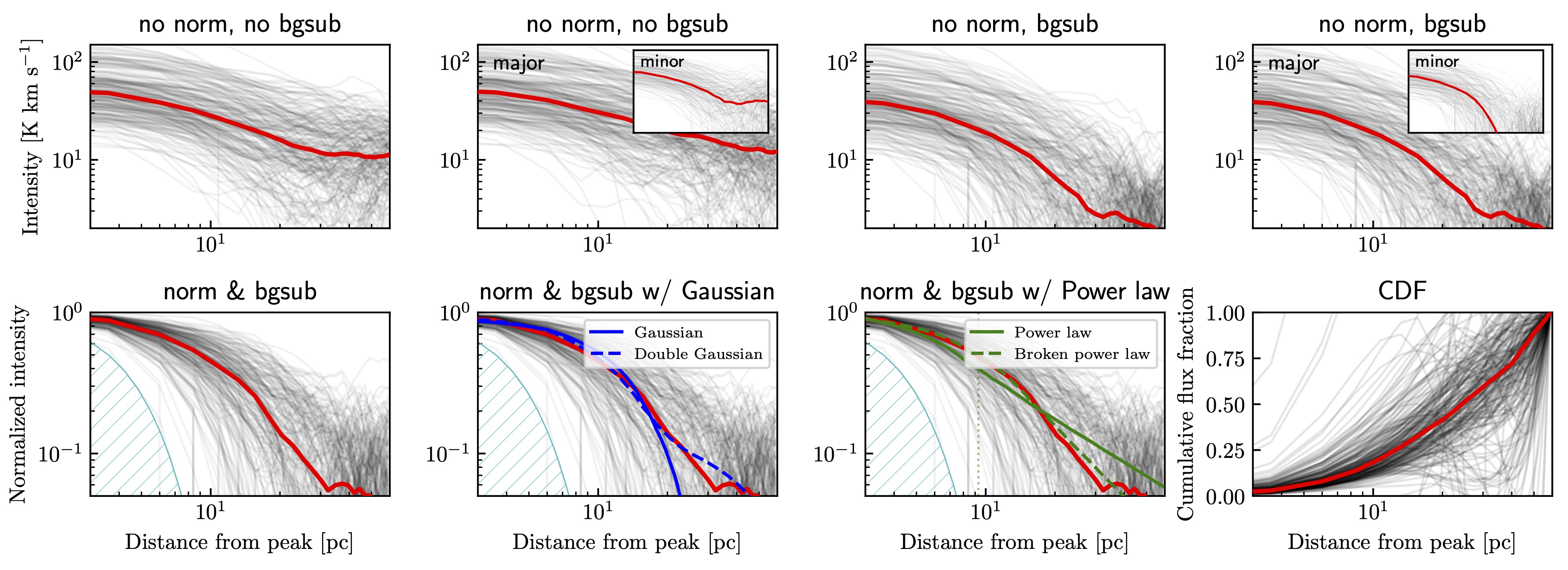
Hundreds of stacked radial profiles for structures in our field. Different panels compare profiles along major/minor axes, and our background and normalization choices. The stacked profiles are well-fit by two component structures, but either Gaussian or power-law models can fit the data.
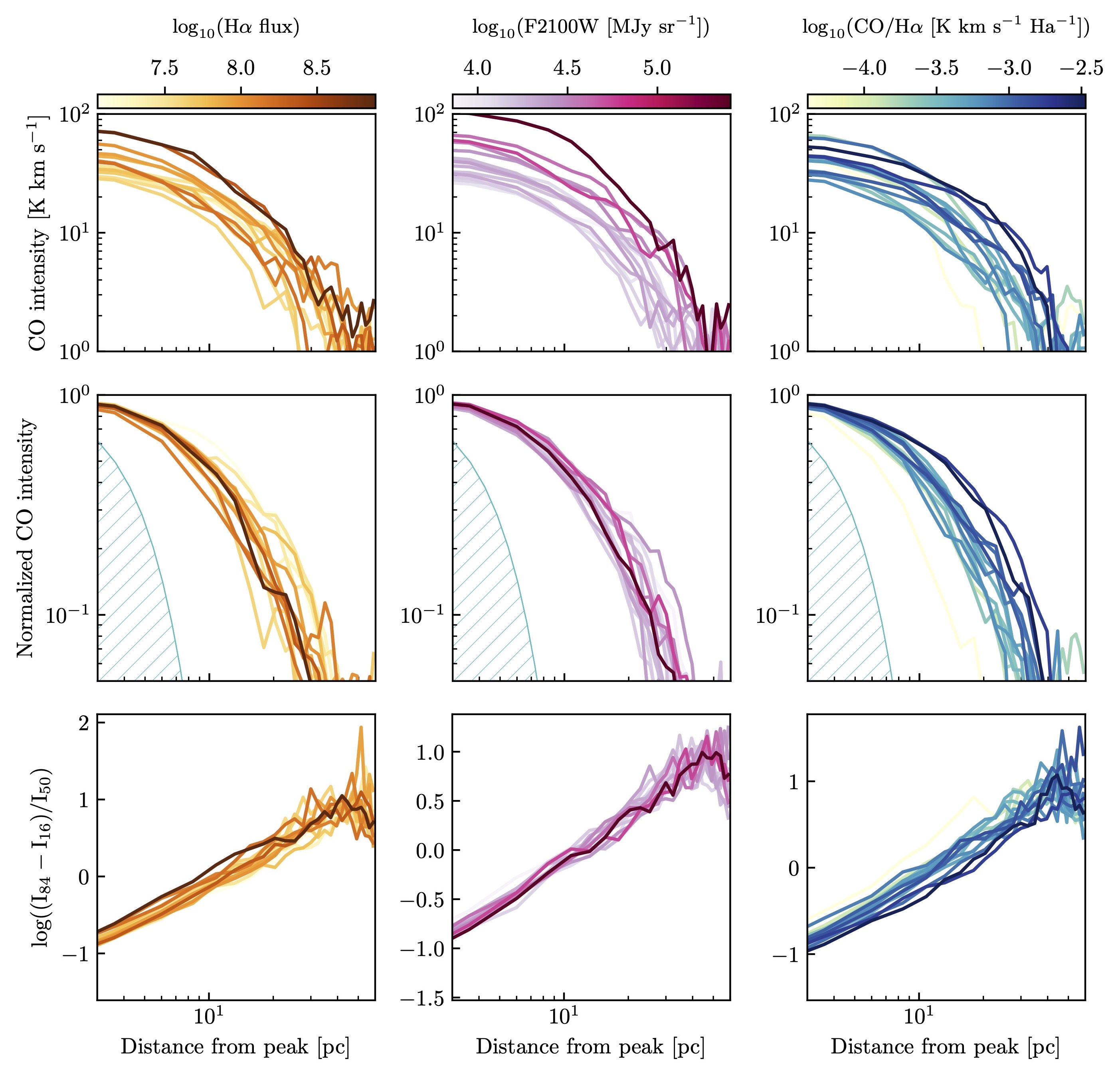
Stacked CO profiles, binned by their association to star-forming tracers (Hα and 21 µm emission). We see subtle but significant differences in the profiles of star-forming vs. non-star-forming structures, which may reflect different physical conditions and evolutionary states.
The NGC 253 zoom field
- Data: 12m + 7m + TP ALMA 12CO(2−1)
- Field: 1.4 × 5.6 kpc2
- Spatial resolution: 0.4'' ~ 7 pc
- Velocity resolution: 1 km/s
- Completeness: ~ 104 solar masses
What does the radial structure of gas tell us about star formation?
The internal density structure of cold molecular clouds governs where, when, and how efficiently stars form, but is poorly constrained on few-parsec scales. We're analyzing the radial profiles of nearly 300 resolved molecular gas peaks in the nearby starburst galaxy NGC 253, to better understand how these structures evolve and collapse to form stars. Our early results suggest that local star formation activity systematically shapes profile geometries at scales of a few to tens of parsecs, with differences between the two star formation tracers hinting at a possible evolutionary sequence.